Wednesday, November 10, 2010
On finding a match
Tuesday, February 02, 2010
Assume Good Intent
Our bad habits, our compulsive disorders and our addictions are all a part of us, not an evil demon riding us. More so, they are a part of us that is not hostile to us and they are not our enemy. They are a part of us that strives to help us as strongly as they can.
The problem is that they are misguided int heir efforts, which is go terribly awry. That is why our weaknesses can become strengths. It is also why recovery from our issues needs to be spiritual, not just physical, to heal that loss of perception and that misguidance that causes us to be self destructive from forces within us that are trying to help us with all their misdirected might.
Recovery, recognition and transformation redirect our mistakes to positive channles where they strengthen us rathr than destroy us (note Ether 12:27). If we have the humility to surrender to God and seek help from a power greater than ourselves, and can do so with honesty, we can find the transcendence we need. We do not lose ourselves, we do not finally free our souls from destructive demons that are riding us; we regain our self. All of it, this time all pulling in the same direction with the same vision.
Last week was my 25th wedding anniversary and the 17th anniversary of Jessica's death. I had some vacation time, but ended up having to go into the office for two days that I had scheduled off that week. Win was sick (but modern antibiotics are a wonderful thing), so all in all it is probably all for the best that our travel plans fell through.
What surprises me is just just how joyful I felt in the week.
On facebook.
Friday, October 09, 2009
Failure in relationships
- Harsh start-ups. When conversations start with criticism, sarcasm or contempt, they are referred to as conversations that have begun with a harsh start-up. A conversation that begins with a harsh start-up will end on a negative note. A harsh start-up pretty much dooms a conversation to negative results, which is a failure. If you have a conversation that begins that way, stop the conversation and start over, whether you started talking that way to a child, a spouse, a co-worker or a subordinate.
- Toxic patterns. There are four.
- criticism rather than complaint. A complaint addresses a specific action or event, criticism is global. "You don't care" or "You are forgetful" or anything that sends the message "something is wrong with you" rather than "something is wrong with what you did" or "please change the way you are acting/what you are doing" is a criticism rather than a complaint.
- contempt. Sarcasm and cynicism reflect contempt. Contempt leads to conflict (obvious or hidden) and withdrawal and preempts reconciliation, blocking it.
- defensiveness. It doesn't work. The hidden message is always "the problem is not me, it is you and I want away from you."
- stonewalling. Tuning out is turning away and giving up, whether you recognize it or not.
- Rejected repair attempts. A repair attempt is a call for a time out, a white flag, an attempt to set things right. When repair attempts are rejected it is a rejection of reconcilliation. For example "you left the milk out and there is a mess." Someone who says "that sure was stupid of me" is making a repair attempt. If you pile on at that point, you are rejecting the attempt. Children often make very blotchy repair attempts. When they do, teach them how to make better attempts, don't just crush the blotch.
- Loss of positive memories. You need to build, refresh, recall, share and nourish positive memories. Positive memories lead to positive attitudes. Do you give someone the benefit of the doubt because of positive attitudes or do you just assume the worst? If you are assuming the worst, you are killing your positive memories.
If you do those things you can repair and save a failing relationship. If you are in a relationship that has those elements, it will probably fail (well, the r^2 on failure is over .83).
Don't ever let yourself start saying "you always" or "you never" or "you are so selfish" or ... unless your goal is to end the relationship. Do spend time every day with a positive memory (the reason for things like gratitude lists). Do share positive memories every day.
You can (and probably should) complain, it is how people help each other improve. Part of a useful boss's feedback is complaints. Properly training a secretary includes teaching them to complain. But universal criticism (as defined above) is useless and toxic. It poisons what should be memories that make a couple glad of each other, replacing those memories with acid burns.
Nourish good memories and good responses instead.
Tuesday, September 29, 2009
Relationships
It is a book on communication, but totally different from the usual approach. The research shows that there is a 90% correlation between some communication patterns and a marriage that succeeds or fails.
Do you have harsh openings when you talk to someone, or do you have gentle ones? When you have a disagreement, do you use sarcasm, do you ever change your mind, do you value your spouse's opinions (and care to hear them) or do you downgrade anyone you disagree with?
Do either of you make repair or soothing attempts, and if one occurs, do you respond to it?
Those are all patterns you can learn to recognize, control and improve.
The book has a lot more than those points, but it teaches them well and they are the core to successful relationships (with friends, at work, or in a marriage). It contains a lot of accessible checklists, advice and patterns you can use. Best, it is data driven rather than modeled on current trends, psych fads or common knowledge and old tales.
Based on it, I've got some rules for talking to a spouse.
- Never say "you always" or "you never" or "you are." That leads to divorce because it devalues your spouse and puts them in the category of "bad" rather than someone you love. If you want not to love them, fine, but otherwise take a different approach.
- Never use sarcasm in any emotional discussion with your spouse. If there is emotion, then you should never belittle, degrade or use sarcasm (you shouldn't anyway).
- Be gentle with each other.
- Never pile on. When a repair attempt occurs (e.g. "you forgot to pick up the milk." [not, "you always forget to pick up the milk"] "I did, that was stupid" -- that is a repair attempt) If you pile on a that stage (e.g. "you sure are stupid!") you are sending the message that you don't want change, you just want to hurt the other person.
- Spend some time each day supporting your spouse's venting. Agree with them, don't try to fix it or offer solutions, don't try to talk them out of venting. Take at least 15 minutes and make sure they do at least 95% of the talking.
Obviously there is a lot more than my conclusions in this book (ok, it may not be obvious, and with some books, there would not be, but there are in this case). Different people will have different take away points (and I have more, but I just wanted five for this post), with different amounts of tangibility (application vs. general principles).
Worth getting through interlibrary loan or used at amazon.com. Bears revisiting and the checklists and quizes are useful for application.
I may do some more posts based on the book.
Tuesday, September 01, 2009
Dominion
I'm quoting from http://www.feministmormonhousewives.org/?p=2629 but this is great relationship material. Visit over there and read the whole thing.
So here’s my deal, we humans, we are a bunch of messed up sinners. All of us. We’re weak and lazy and selfish and power hungry. I think most all of us would like a dominion in which we are fanned by palm fronds and fed pealed grapes while receiving a foot massage and being read to by Morgan Freeman. Whilst sending our minions off to buy more jello and clean the toilets. Sigh.
But a righteous dominion must exist, no? Or there would be no need to warn of the unrighteous variety. I don’t know if in any substantial way dominion is different from the leadership, the words certainly feel different to me, to be led or to be dominated, even righteously.
THE HANDOUTEach husband, each father, should ask some questions of himself to see if he may be on the borderline of unrighteous dominion:
1. Do I criticize family members more than I compliment them?
2. Do I insist that family members obey me because I am the father or husband and hold the priesthood?
3. Do I seek happiness more at work or somewhere other than in my home?
4. Do my children seem reluctant to talk to me about some of their feelings and concerns?
5. Do I attempt to guarantee my place of authority by physical discipline or punishment?
6. Do I find myself setting and enforcing numerous rules to control family members?
7. Do family members appear to be fearful of me?
8. Do I feel threatened by the notion of sharing with other family members the power and responsibility for decision making in the family?
9. Is my wife highly dependent on me and unable to make decisions for herself?
10. Does my wife complain that she has insufficient funds to manage the household because I control all the money?
11. Do I insist on being the main source of inspiration for each individual family member rather than teaching each child to listen to the Spirit?
12. Do I often feel angry and critical toward family members?
To which, let me add my own bit of poetry:
WATER
a medley by Steve Marsh
a man is supple and weak when living
hard and stiff when dead
No power or influence can be maintained, except
the hard and the strong are the signs of death
the supple and changing the signs of life
by persuasion, by long suffering, by meekness and by gentleness
that which is forceful will not vanquish
that which is strong will fall to the axe
by kindness and pure knowledge
the strong fails
the supple succeeds
without hypocrisy and without guile
nothing is more submissive and weak than water
yet for breaking mountains, nothing can surpass it
Charity and virtue
that the weak overcome the strong, the
submissive the hard, all know
Yet none can put it into practice
Then the priesthood shall distill upon thy soul
as the dew from heaven and without
compulsory means dominion
shall flow unto thee
Forever and ever
Lao Tze
Tao Te Ching
Joseph Smith
Doctrine and Covenants 121
Monday, February 02, 2009
No ifs, ands or buts ...
I just read a post about saying "I love you." Same rules apply to saying "I love you" as do to saying "I'm sorry." You wouldn't say "I'm sorry, even though ..." and you don't do that with "I love you." (Even more so, "I love you even though" carries the message "I love you even though you aren't lovable.")
The only difference is that if someone says something, you can say "what do I care, I love you" in response or similar words. But, you can't say "I don't care about x, I love you anyway." That "anyway" is a killer, though the "I don't care" might be appropriate. Kind of like if you are apologizing and the other person says "yeah, but it was really my fault because" you might say "I don't care about" "I'm sorry."
In an apology, the only "and" you can add is "and I won't do that again." In "I love you" the only "and" you can add is "and I always will."
And always should.
Monday, January 05, 2009
Thank you for that information
But one thing that is important to do, and that I'm still learning, is when someone tells you something you already know, don't say "I already knew that" but instead say "Thank you" or "Thank you for sharing that." And don't say "Thank you for sharing that, but I already knew it." Too many times we should just stop with the "Thank you" without adding anything more.
That is something I plan to work on more this coming year, saying "Thank you" without more and without qualifying.
Thursday, December 18, 2008
More Relationship Advice -- Absence ...
With your parents and siblings you probably learned about absence by going to camp or away on a mission or off to school. If you use that for your model when work takes you out of town from a wife or husband and children for a month or more, you will make serious miss-steps.
There is a period of roughness, anger even, that goes with being reunited with a spouse and children when you have been gone. Young children are transparent. They just get angry when you come back (though they get over it in a day or so). You need to expect the same emotional waves to affect older children and your spouse and be ready for it, to just patiently take the time to re-engage.
Think of it as shifting into gear after starting a car that is cold. Do you skip using the clutch or letting the car warm up? If you do, things grind.
Anyway, just thought I'd post a comment on that, since most of us will have a time in our lives like that, when we are away for a month or two. I've been lucky, but my dad was in the Air Force and had TDY assignments, Viet Nam and Korea.
Not to mention, sometimes we feel emotions in regards to God that we aren't comfortable with and need to work through, just as when others are absent.
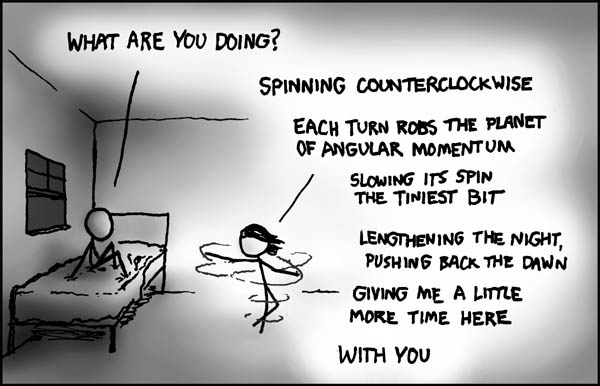
BTW, this comic made me think of my wife:
Friday, September 26, 2008
Advice from Win
There are two stories that I want to share with you.
My daughter Courtney turned a year old just 2 weeks after my oldest daugthter died. I was not emotionally ready to celebrate anything, AND, at a year of age, Courtney would not know the difference. So .. No party. 11 months later, Courtney died. I still feel guilt that I never had a party for her.
When my oldest daughter was in the hospital and we found out that she was not going to live, a friend stopped by. She had lost a son at the age of 4. She made a statement that has stuck with me. She said, " You are going to have to decide how much else you are willing to lose." I gave her a confused look. She continued, " When you lose a child, it is all too easy to make that loss your focus. If you do that, you will lose other things also. You will lose your marriage, your other children, your job, your friends. Everything else will be gone. You have to decide how much more you willing to lose."
"How much more am I willing to lose?" That became the statement that I would repeat to myself in my head. That statement made me get up and do things with my other children. It made me focus on my marriage, it made me try to interact with other people.
Your son's death had nothing to do with goodness and evil, wrong or right. You did nothing to "earn" or "deserve"
this tragedy im your life. Horrible things happen in this life. I don' think we really notice all the tragedy in this world until we are personally involved. Grief opens our eyes and our hearts to different emotions. I think it connects us-- as individuals to the rest of humanity.
It is hard to breath somedays while learning to handle loss. Work on it. Make yourself breath, and walk, and care. Claim your life, make yourself love again. You will lose too much if you don't force yourself to move forward. Take the memories of your son, think of all the things you would do with him if he was still here, and do those things with your other children. You don't know what your future holds .. Love them while you can.
Take your grief, hold it tightly, don't let it go, but keep moving forward. I know that you can do it.
Sunday, August 24, 2008
Being a Father and a Husband
As a Father
- do not rush past fleeting moments
- do not over-schedule your child or children
- cut out excess commitments and encourage your wife to find time for herself
- find regular times to talk with each child every week
- pray, study and teach the gospel.
- notice what your wife does -- often and with positive feedback
- have regular times to talk about each child
- give your spouse time away from the children
- when you come home, engage your family, give your wife a break every time you come home as soon as you come home.
- actively interact with your family as soon as you come home (rather than getting into the habit of spending time decompressing).
I'm trying to incorporate those lessons.
On having a winning attitude: example
On how the example got that attitude
I like the blogger's attitude who wrote the second essay and have added them to my blogroll links so I don't forget to visit.
Friday, July 18, 2008
From The Religious Language Newsletter, etc.
It begins with:
"Of the several negative communication patterns congregations practice, three
habits are particularly problematic: triangulation, pass-through communication,
and anonymous feedback. While these three may be strategies for getting needs
met, they all block rather than help healthy communication. Even if well
intentioned, they are deadly habits that in the long run allow people to
dodge accountability, gain power, and alienate others."
Persuasion principles
Much of persuasion and other forms of changing minds is based on a relatively small number of principles. If you can understand the principles, then you can invent your own techniques. It thus makes sense to spend time to understand these principles (persuaded yet?).
Alignment: When everything lines up, there are no contradictions to cause disagreement.
Amplification: Make the important bits bigger and other bits smaller.
Appeal: If asked nicely, we will follow the rules we have made for ourselves.
Arousal: When I am aroused I am full engaged and hence more likely to pay attention.
Association: Our thoughts are connected. Think one thing and the next is automatic.
Assumption: Acting as if something is true often makes it true.
Attention: Make sure they are listening before you try to sell them something.
Authority: Use your authority and others will obey.
Bonding: I will usually do what my friends ask of me, without negotiation.
Closure: Close the door of thinking and the deal is done.
Completion: We need to complete that which is started.
Confidence: If I am confident, then you can be confident.
Confusion: A drowning person will clutch at a straw. So will a confused one.
Consistency: We like to maintain consistency between what we think, say and do.
Contrast: We notice and decide by difference between two things, not absolute measures.
Daring: If you dare me to do something, I daren't not do it.
Deception: Convincing by trickery.
Dependence: If you are dependent on me, I can use this as a lever to persuade you.
Distraction: If I distract your attention, I can then slip around your guard.
Evidence: I cannot deny what I see with my own eyes.
Exchange: if I do something for you, then you are obliged to do something for me.
Experience: I cannot deny what I experience for myself.
Fragmentation: Break up the problem into agreeable parts.
Framing: Meaning depends on context. So control the context.
Harmony: Go with the flow to build trust and create subtle shifts.
Hurt and Rescue: Make them uncomfortable then throw them a rope.
Interest: If I am interested then I will pay attention.
Investment: If I have invested in something, I do not want to waste that investment.
Involvement: Action leads to commitment.
Logic: What makes sense must be true.
Objectivity: Standing back decreases emotion and increases logic.
Obligation: Creating a duty that must be discharged.
Passion: Enthusiasm is catching.
Perception: Perception is reality. So manage it.
Pull: Create attraction that pulls people in.
Push: I give you no option but to obey.
Repetition: If something happens often enough, I will eventually be persuaded.
Understanding:If I understand you, then I can interact more accurately with you.
The site these are extracted from has a lot more. Think about when you were persuaded last, were you manipulated?
GLIBIDITY, Slang. a condition
in which a person gives very glib answers.
from www.carolineletkeman.org
Wednesday, June 25, 2008
On giving advice
- The role and responsibilities of the person on the other side of the table. See the situation from their perspective.
- Your intentions -- keep them pure
- The delivery itself -- focus on tone and spirit in which advice is delivered. This is crucial.
- Summary -- close off the interaction, make sure everyone is on the same page. Whether it's a one minute conversation or four hour meeting, get some closure and action items.
Actionable advice is best advice. Saying "speak up more" to someone who doesn't talk in meetings is not actionable; saying "say at least three things in the meeting" is more clearly actionable.
That is a good point to remember. Give actionable advice, actions to take rather than principles. Do it with a "because" linked to the principle. E.g. "Say at least three things in the meeting because you need to speak up more" ties together actionable advice with principle advice (and uses the because rule, that advice with the word "because" in it, is better absorbed).
Saturday, May 17, 2008
Betrayal
- a mother whose only boy has died, and who can't have any other children, and who feels betrayed that God has left her without sons;
- a father whose wife has become an alcoholic and whose children are losing their way;
- someone whose interaction with food has gone terribly wrong and who can't stop gaining weight;
- people recovering from disasters who feel that calamity should not have befallen them;
- a kid who wants to serve a mission but who has developing mental illness issues that medication doesn't quite resolve;
- the list goes on.
Many people who have read my blog know that I've been reading 12-step literature in the hope that it would apply to grief. It does, a little, sometimes. I've written about that too.
But, and this is a big but, there is one area where there is a 12-step group that has feelings of betrayal and resentment down cold. That group is Al Anon. Al Anon is a group for people who have an alcoholic in the family (one of the sub-groups is for kids who have to deal with an alcoholic parent). They have a lot of literature. But, a constant theme, over and over again, is dealing with feelings of betrayal, resentment and the need to control someone else.
This is especially true when people feel betrayed by God in what has happened to them.
Yes, I'd advocate anyone with those emotions to seek counseling. But, you can read things (e.g. here on the official site, and an excellent collection of essays on-line here). No matter what is causing the feelings (and alcoholics often are unfaithful, mentally ill, betrayers -- that is all part of the disease), they have an excellent tool set to help you while a professional gives you additional support.
No question, I value The Anatomy of Peace. But if you need more, there are books like One Day at a Time in Al-Anon (available for 12 cents or so used on Amazon and probably in your local library) that can help with the emotional states, to give you encouragement and hope in dealing with the pain, confusion and anguish.
That can help you find peace.
For some "middle age crazy" links:
Wednesday, February 20, 2008
Being truly sorry -- when I was wrong, I waited to admit it.
I don't explain, I don't defend, and I don't apologize before they are finished complaining.
A twist on what many advise, but I find that if I just wait a little, it means a lot to the person who is complaining. If I'm sorry, letting them finish venting before I admit I was wrong and apologize, that brief waiting is little of a price to pay.
And if I'm really sorry, it has hit me that what I do is say "I was wrong, I apologize" followed by (if appropriate) "what can I do to make up for that" or "ok, I'll be doing xyz to make up for that, can you suggest anything else?"
That is what it really means to be sorry, and what it really takes to communicate that I am sorry.
Sunday, December 16, 2007
Hello Gorgeous
Well, I'm in a mediation, our side has four claims representatives and three attorneys and she calls and I answer my cell phone. Next thing I know, everyone is looking at me.
It is getting late, one of the other guy's wife calls, and he tries that same answer. Immediate disconnect, he jokes "she must have thought it was a wrong number" but he calls back and stays on task.
The third guy's wife called (we went really late, missed a lot of things, it was a Friday night). "Hello gorgeous" he goes and doesn't miss a beat.
By the end of the night everyone had decided to adopt the nick name I have for my wife for their own. It was kind of neat.
Sunday, December 09, 2007
Seasons of the heart, Christmas
Jessica was so excited about being baptized. I've not known a kid not quite seven who was so enthused about getting to eight to be baptized. Now, Rachel is about to turn eight and it just brings back and lot of feelings. We head towards Christmas, where Courtney died on the 26th of December and Rachel was admitted to the hospital then, and it is a cold month, in so many ways, and this year, more than many before, a very hard month to face.
But, we got a tree, got it decorated, had the pets eat everything on the bottom few branches, and we have lights up (out of reach of the pets outside).
Wish I had better advice for weathering the seasons of the heart.
BTW, ethics, fair trade and everything else aside, http://peaceworks.com/product_info.php?cPath=21&products_id=28 is a link to the best granola bars I've ever found.
I've simplified my modified Shangri-la calories as well.
2 ice cubes, one cup of water, 1/4 cup oatmeal, 1.5 scoops protein powder, 2 tablespoons extra light olive oil, blend well (using a blender), drink right after getting up, no flavor for an hour, then I brush my teeth and go to work. It is simple, easiest two hour block of time to find (since I'm spending an hour of it sleeping), replaces breakfast and seems to work well. The powder binds up the oil and it is the most gag free approach I've found. A number of people use nose clips, but if you use Designer Whey, unflavored, it is pretty much flavor free with or without the nose clips.
Contains enough protein that you don't have to pay special attention to getting enough protein while losing weight.
Wednesday, December 05, 2007
When is enough, enough?
If I were guessing, I'll bet she likes what she sees, but ...
She was probably happy with what she saw ten pounds ago. You've hit the point she is happy about you, now she wants to know just how much further this goes, how much time you are taking away from her, how much more money you are going to spend.
Does that make any sense? Kind of like when a guy has a hobby. An hour a week, might make your wife smile and have her encouraging you. Forty hours a week, she is going to throw tantrums.
Five dollars a week? She may not even notice. Five hundred dollars a week, a surgeon making two million a year can get away with it, but the rest of us are going to be putting a major strain on a relationship.
She is really asking is this a supplement to your relationship or a replacement? When is enough really enough (and when does it become too much)?
From a discussion about wives and hobbies (this one by a weightlifter/ bodybuilder, but) the principle applies across the board to self improvement and hobbies and projects. It is important to ask yourself how what you are doing comes across. Is it a supplement to your life or is it a replacement for a part of it?
Saturday, October 06, 2007
"It was only a girl who died, that doesn't matter,"she said
If you had lost a son, then you would know grief. All you've buried is worthless daughters, what do you know of loss!That is a real statement from a real person, who will remain nameless. They felt the way they felt with some vehemence. Why? Was it because they were narcissistic? Was it because they were misogynistic? Was it because they were so ego driven and competitive they had to win in any venue?
Who knows, who cares? The reality is that they were in grief, and severe grief makes logical paupers of us all. None of the obvious responses to such a statement helps anyone. Not the poor parent driven somewhat beyond reason by the death of a child. They don't need deconstruction or enlightenment or re-education just right now.
People watching do not need to see someone in pain given more pain. They might be vicious enough or callous enough to enjoy it, but they don't need it and no one should have the desire to give them a show. Even more, a person on the other end of such a statement isn't any closer to serenity or charity if they forget to be sad and patient, to mourn with those who mourn.
It is important when dealing with others who grieve not to let it become competitive. It is important not to let attempts to compete or dominate by others, afflict us or affect us. Remembering to treat competitive statements as just one more way people are driven past reason by grief and evidence helps me remember that they need help and love. That people really need love and patience is a useful perspective.
It is also one that it is useful to let carry over into your life outside of grief. Grief, especially the severe grief of losing a child, is just terrible stress, writ large (the phrase "writ large" just means just bigger and worse). If you take just a moment, it is easy to see people as being deformed by stress -- remembering that one meaning of to be deformed is to be pushed out of your natural shape.
Rather than thinking of those who say terrible things as malformed (better than using "deformed" in the sense of formed wrong or inherently defective), if you see them as deformed by stress and life, you can also see them as able to be restored by love and patience.
Having love and patience is what charity is really about. In many ways it is just taking the time to help our brothers and sisters, and to help ourselves, be restored to our proper form, undeformed by stress. As my dearest wife pointed out to me, hearing such statements, and their cousins, should be a reminder that people need love and patience, not a reason to abandon it.
Have I been patient long enough?
But in other cases, 99% of what we encounter in our lives, the answer is that if you are asking the question then you haven't been.
Too often we have been part of whatever the problem is, and not outside, nourishing and helping, anywhere near long enough. One thing I've gotten from Leadership and Self Deception: Getting Out of the Box is that a belief I've had, that you can make a difference if you just take the time it takes, is true -- and that many, many times, we have not taken the right steps, in the right way for anywhere near enough time.
On thing grief has done for me is teach me that things take time. It has also taught me that so many things I thought or think I am doing are not the same the way I see them as others see them. I see that so often with others that I am certain that it must apply to me as well, and that just like they do not see it in themselves, I can't see it in myself.
The approach of patient, caring love seems like the only answer.
Tuesday, September 18, 2007
One book
by Suzette Haden Elgin (Jan, 1996)
In Stock
Price: $15.95
45 used & new from $0.97
When I used to do volunteer work for womens sheltered and battered women, I probably bought and gave away over a hundred copies of this book. I even started getting the bulk institutional discount from the publisher.
I really like Elgin's books, I love my children, and I still recommend this book, even if I've been buying copies of The Bottom Line On Integrity to give away these days and am currently reading more Arbringer Institute books.
If you were going to recommend one book, what book would it be?